apunta.io: a CRM you run by talking to it
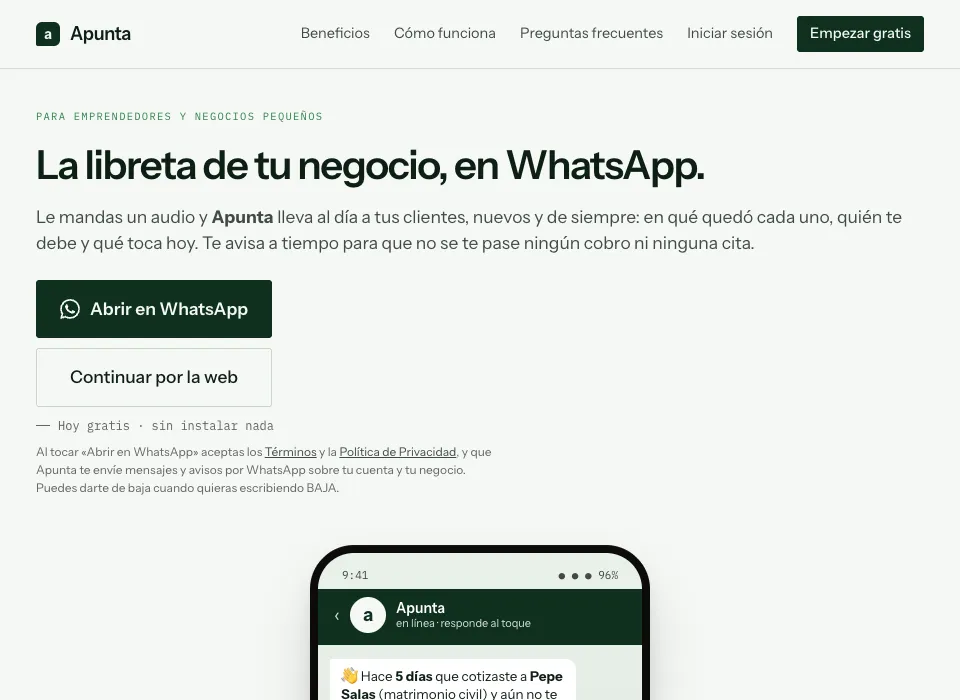
An assistant on WhatsApp that keeps a small business’s clients, agenda and payments in order. The owner sends a text, a voice note or a photo, and the assistant does the bookkeeping. The hard part was making it safe to trust with someone’s money.
- Role
- Founder, sole engineer
- Started
- 2026
- Status
- Live, apunta.io
The problem
Hairdressers, bakers, caterers and small shop owners in Peru run their business from their phone, mostly on WhatsApp. I researched what hurt the most. The answer wasn’t a missing feature: it was collecting money they were already owed. Asking a client to pay is uncomfortable, so it gets put off, and cash flow is one of the main reasons small businesses close.
These owners have no time for forms or dashboards. They already talk in voice notes and send photos of payment receipts, so the product had to work the same way.
How it works
- A message arrives from WhatsApp. It’s verified and put on a queue, and each message is processed exactly once even if WhatsApp delivers it twice.
- Voice notes are transcribed, and photos of receipts or handwritten notebooks are read into structured data.
- The assistant decides what to do and calls one of around 60 actions: add a client, record a payment, set up an installment plan, schedule an appointment, send a reminder.
- It replies in the same chat, with buttons when the owner needs to choose.
Not every action is available all the time. A new user only sees the handful needed to get started, and collections or agenda tools appear once there’s data for them. That way the assistant only weighs what’s relevant to that business right now.
Making it safe to trust
- Every action is scoped to one business. The assistant can only reach the data of the business that’s talking to it, by construction, not by instruction.
- Nothing touching money happens without a yes. Recording or deleting a payment or expense, and similar actions, first come back as a proposal. They only run after the owner confirms.
- Everything is on the record. Every action the assistant takes is logged with its input and result, so any surprise can be traced.
- It remembers carefully. It keeps a small set of facts about each business. Facts the owner states directly can’t be overwritten by something the assistant inferred on its own.
Testing an assistant
Unit tests can’t tell you whether a conversation went well, so I built an evaluation harness. Each scenario has a persona, a goal and starting data. A simulated business owner chats with the real assistant, and at the end the database is checked for what should have happened: the payment exists, the reminder is set, nothing was created twice.
A separate model also grades the conversation, but the pass or fail comes from the database checks, which don’t change between runs. Some scenarios come straight from real incidents, like a client’s auto-reply that kept the assistant in a loop.
The same harness is how I choose models. I compared several providers on the same set of cases for quality, cost and speed, and each job uses a different one: one for the conversation, one for transcribing voice and one for reading images.
In numbers
- Eval scenarios
- 145
- Test files
- 360+
- Assistant actions
- About 60